

Stealing signs has been part of baseball since the sport existed, but it became a genuine competitive integrity problem once technology made sign-stealing easier than ever. PitchCom was built specifically to end that arms race — an encrypted, audio-and-visual communication system that lets catchers and coaches send pitch calls and defensive signals directly to players, without a single sign getting intercepted. After going through their full system lineup, adoption story, and media coverage, here's a complete breakdown of why this device has become close to universal in professional and college baseball.
Since 2022, every MLB team has trusted PitchCom to secure pitch calls and defensive signals, and the brand states that every Men's College World Series champion has relied on the system since its introduction to the college ranks.
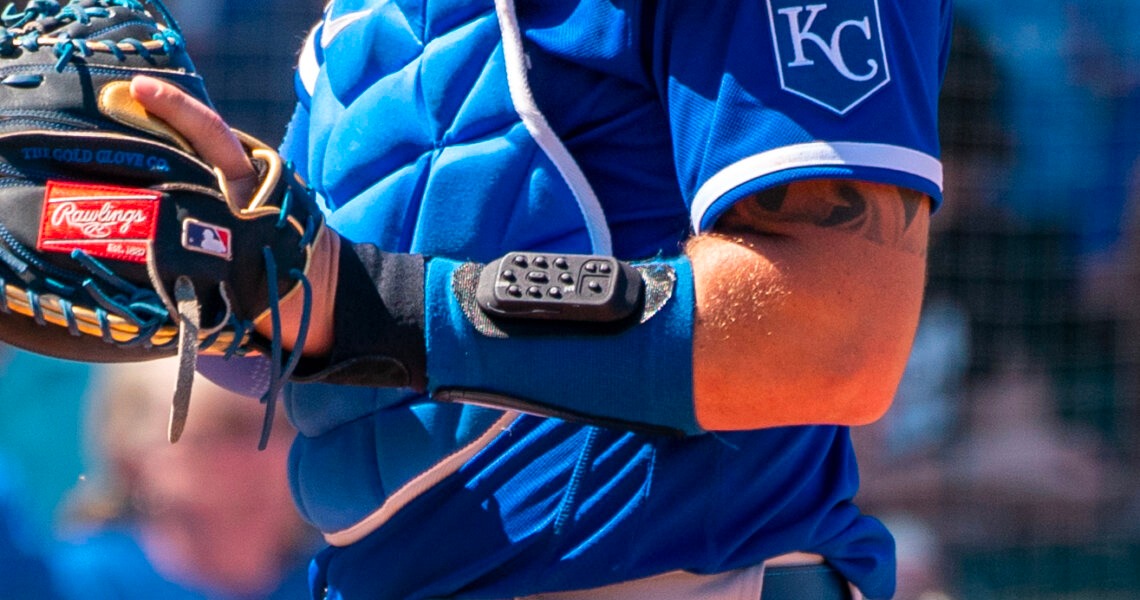
Traditional sign-calling — a catcher flashing fingers between their legs — has always been vulnerable to an opposing team with a good enough eye (or, in some infamous cases, less legitimate methods) figuring out the pattern. PitchCom removes that vulnerability entirely by sending pitch calls as encrypted audio directly to a small receiver in the pitcher's cap, with no visual signal for an opposing dugout or baserunner to decode in the first place.
Transmitter Remote. A programmable coach-to-player control device, typically operated by the catcher (or a coach, for defensive signals), used to select and send a specific signal instantly with the push of a button.
Audio Receiver. Worn by the pitcher (and other fielders as needed), this component receives the encrypted audio signal and plays back a pre-recorded, customizable audio track — meaning the exact wording of every signal can be fully personalized rather than relying on generic pitch-type callouts.
Visual Receiver. A dual-tone display interface designed for the best possible visibility, offering an alternative or supplementary way to receive signals depending on team and player preference.
Total Awareness. Because it's an audio system rather than a visual wristband or tablet, players stay focused on the field and the game itself rather than glancing down at a device — a meaningful safety and performance advantage in a sport where split-second reaction time matters.
Speed. The system can select and send thousands of possible signal combinations in under a second with a single button press, considerably faster than any traditional hand-signal sequence.
Durability. Designed and safety-tested specifically for MLB use, the hardware is built for the demands of a full professional season, used by catchers and third base coaches without needing tablets or phones on the field.
Battery Life. Receivers offer 5+ hours of battery life, while the transmitter is rated for 24+ hours — enough for a full game (or several) without needing a recharge mid-action.
Direct Radio Connection. Rather than relying on cellular data or WiFi, PitchCom uses a direct radio connection, which the brand states makes it reliable everywhere from MLB stadiums to remote practice backfields where cell service might be spotty or crowded.
Unlimited Customization. Coaches can record audio tracks saying literally anything they want, with no limitations on text characters — a level of flexibility that goes beyond simply relaying a pitch type and location.
PitchCom's most striking claim is genuinely remarkable if accurate: millions of signals called across professional and collegiate baseball since 2022, with zero signals stolen, thanks to encryption technology the brand describes as unhackable. Given how widely and publicly the system has been used — across MLB, nearly all top Division 1 programs, and increasingly softball and even football — this is a claim that's been tested at enormous scale rather than just an internal assertion.
Beyond MLB and college baseball, PitchCom has expanded into softball (partnering with USA Softball, Alliance Fastpitch, and the AUSL professional softball league through 2028), and even football, having debuted with CFL defenses and drawing coverage from USA Today and Sports Business Journal for that crossover. The system is also the exclusive communication system of SEC Baseball and has multi-year agreements with conferences like the ACC — reflecting genuinely deep institutional adoption rather than scattered team-by-team purchases.
Feedback from head coaches at major programs is consistently enthusiastic. Stanford's head coach specifically credited the system with giving pitchers more time to mentally prepare for a pitch and helping eliminate pitch clock violations entirely. LSU Softball's head coach praised the clarity of communication and ease of use as a program-wide improvement. Washington State's head coach specifically highlighted the time saved on sign-relay training with pitchers and catchers, freeing up practice time for other priorities.
PitchCom has picked up an unusually broad range of mainstream media coverage for a sports equipment company — spanning ESPN, Sports Illustrated, Time, The New York Times, The Washington Post, Good Morning America, SiriusXM, MLB Network, and several major newspapers — reflecting its status as one of the more genuinely newsworthy pieces of sports technology in recent memory, given its role in reshaping how the sport handles sign security.
NCAA & NFHS Compliant. The system is explicitly compliant with both college and high school rules, meaning it can legally be used at every level of organized play, not just professionally.
Ready to Go Out of the Box. Systems arrive with default signals pre-loaded and ready to use, with the option to fully customize signs afterward — reducing setup friction for teams that want to start using it immediately.
Fast Shipping & Support. Orders ship within two business days, backed by dedicated phone and email customer service.
Patent-Protected Technology. PitchCom holds multiple registered US patents on its core technology, reinforcing that this is a genuinely proprietary system rather than an easily replicated gadget.
Starter Option. For amateur baseball and softball programs specifically (rather than professional or major college programs), PitchCom offers a Starter system, positioned with no contracts and full ownership rather than a subscription model — a meaningful accessibility option for smaller programs.
A genuinely verified security track record. Zero stolen signals across millions of calls, at the highest levels of professional and collegiate baseball, is about as strong a real-world proof point as a security-focused product could hope to demonstrate.
Consistent praise across very different program types. Getting enthusiastic, specific endorsements from Division 1 baseball and softball coaches alike suggests the system's benefits (speed, clarity, reduced training time) translate across different levels and styles of the sport.
Expansion beyond baseball validates the core technology. Successfully crossing over into football with the CFL suggests the underlying communication technology has genuine value beyond just baseball's specific sign-stealing problem.
No subscription lock-in for amateur teams. The Starter system's "no contracts, you own it" positioning is a meaningful, buyer-friendly structure compared to a recurring software-style subscription model.
Deep institutional partnerships, not just individual team sales. Being the exclusive system of SEC Baseball and holding multi-year conference-wide agreements with organizations like the ACC and AUSL shows a level of trust that goes well beyond isolated purchase decisions.
This is specialized team equipment, not a casual purchase. PitchCom is designed for organized programs — high school, college, amateur leagues, or professional teams — rather than individual recreational players, so it's worth reaching out via their quote request process rather than expecting simple e-commerce checkout pricing for full team systems.
Battery management still matters. While battery life is strong (5+ hours for receivers, 24+ for the transmitter), teams running long practices or doubleheaders should still factor charging routines into their pre-game preparation.
Effectiveness depends on proper setup and training. Getting the full speed and clarity benefits requires actually customizing and training players on the system's signal library rather than just relying on default settings indefinitely.
For any organized baseball or softball program — from high school up through professional leagues — PitchCom has become close to the industry standard for a good reason. The combination of a genuinely unmatched, publicly verified security track record, near-universal adoption across MLB, top college programs, and multiple softball leagues, strong and specific coach endorsements, and a no-contract ownership option for amateur programs makes it an easy recommendation for any team serious about protecting its signs and speeding up in-game communication.