If you run a recruiting, executive search, or staffing agency and keep hearing Recruiterflow come up alongside Bullhorn, Loxo, and Crelate, here are the answers to the questions people most often ask before switching.

Recruiterflow is an AI-native ATS (applicant tracking system) and CRM built specifically for executive search firms, recruiting agencies, and staffing agencies. It combines candidate pipeline tracking, client relationship management, multichannel outreach sequences, workflow automation, and a suite of AI agents into a single platform, rather than treating AI as a bolted-on add-on to an older system.
Recruiterflow positions itself directly against the idea that agencies have to choose between depth (mature, enterprise-grade features) and AI capability (modern, intelligent automation). Legacy systems, in its framing, offer the customization and depth needed to run a serious search business but haven't meaningfully modernized with AI. Recruiterflow's pitch is that it was built AI-native from a more recent starting point while still building out the depth — reporting, automation, permissions — that established agencies expect.
Recruiterflow points to a specific timeline of AI features shipped well ahead of the industry: automated outreach sequences in 2019, workflow automation in 2021, agentic features in the interface months after ChatGPT's public launch, and a suite of 36 built-in AI agents (branded AIRA) by 2024-25, with agentic orchestration connecting multiple agents together by 2026. Whether or not you weigh that history heavily, it does indicate the AI features are integrated into core workflows rather than a separate add-on module.
Two AI capabilities worth understanding specifically: AIRA Search, described as natural language search that can interpret what a recruiter means rather than requiring exact keyword matches, and AIRA Notetaker, which automatically summarizes key points from candidate calls so recruiters aren't manually writing up call notes after every conversation. There's also Job Change Alerts, which tracks when candidates in your database switch roles or companies — useful for staying on top of passive candidates without manually re-checking LinkedIn.
Beyond AI, Recruiterflow includes an integrated ATS and CRM, multichannel sequencing (email, LinkedIn, and phone in one outreach flow), workflow automation for recurring admin tasks, advanced reporting through what it calls Recruiterflow BI, and goals/leaderboard tracking for teams. On the compliance and reliability side, it's SOC 2 and ISO 27001 certified, GDPR compliant, and offers SLA-backed support, dedicated implementation help, and role-based permissions — the kind of features agencies moving off a legacy platform typically expect.
Recruiterflow offers an open API specifically to avoid forcing agencies to work in silos, along with a broader set of third-party integrations. If your agency already has a stack of sourcing, communication, or reporting tools, this is worth checking against your specific list before migrating.
Recruiterflow publishes several case studies with specific figures: one search firm reported doubling submittals and scaling revenue 4x, alongside a 76% reduction in time-to-fill. Another staffing agency reported tripling productivity and generating 3x more job orders compared to their previous software. A CRM-focused case study reported a 65% reduction in time-to-fill after restructuring around Recruiterflow's CRM. These are agency-reported outcomes rather than independently audited figures, so it's worth treating them as illustrative rather than guaranteed results for any specific firm.
The platform is squarely aimed at recruiting, executive search, and staffing agencies — not internal corporate talent acquisition teams. Agencies running high-volume, multichannel candidate outreach with client relationship management on top are the clearest fit, especially those currently on an older ATS and looking for a genuine AI upgrade rather than a bolt-on chatbot.
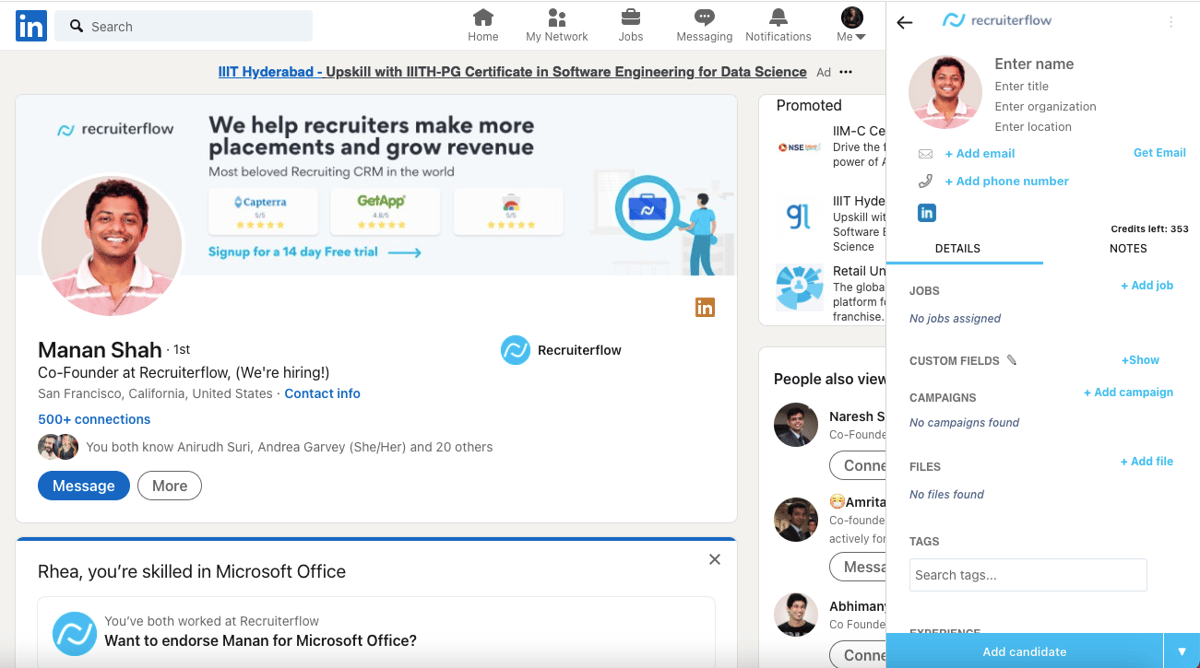
Recruiterflow maintains direct comparison pages against Bullhorn, Loxo, Crelate, Vincere, and RecruitCRM, suggesting these are the platforms agencies most often evaluate side by side. If you're actively comparing options, it's worth reviewing those specific comparisons for feature-by-feature differences rather than relying on marketing claims alone from any single vendor.
If your agency is trying to modernize away from a legacy ATS without losing the depth needed to run day-to-day operations — reporting, permissions, compliance — Recruiterflow's combination of AI agents built into core workflows and enterprise-grade infrastructure makes it a reasonable platform to evaluate directly against your current tool.
You can check out Recruiterflow for yourself here to see how it fits your agency's workflow.